
13 July 2026
How Do You Measure Structural Debt?
The invisible risk that doesn't appear on your balance sheet.
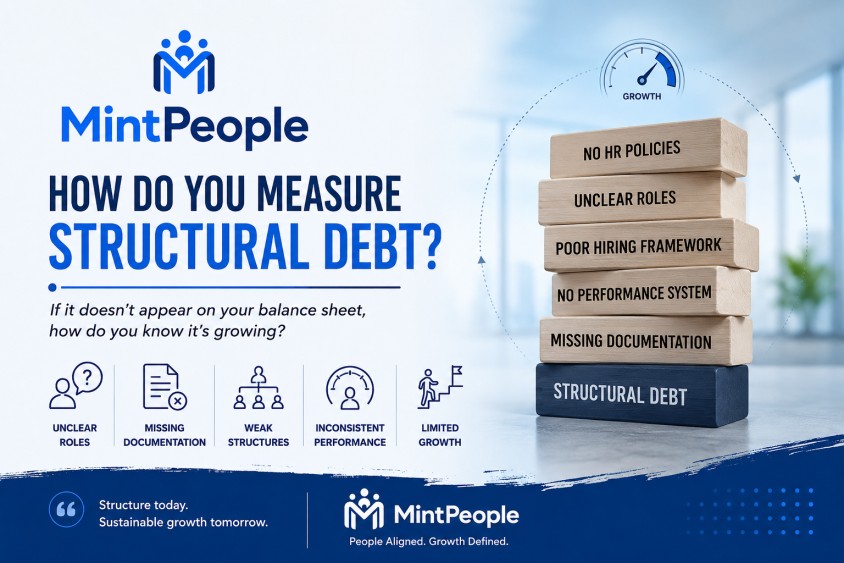
When I first introduced the concept of Structural Debt, one question came up repeatedly:
"If it's invisible, how do we measure it?"
Unlike financial debt, Structural Debt doesn't appear in accounting records. Unlike technical debt, it doesn't show up in product backlogs. Instead, it quietly accumulates through the everyday decisions organizations postpone.
It begins with statements that sound perfectly reasonable:
"We'll document the process later."
"We don't need HR policies yet."
"Everyone already knows their role."
"Let's hire first and define responsibilities later."
Individually, these decisions seem harmless. Collectively, they become the invisible liabilities that make organizations harder to scale.
The real measure of Structural Debt isn't the number of policies you have—it's the number of problems you repeatedly solve.
If employees constantly seek clarity on responsibilities, approvals, or processes, it signals that structure is missing. If operations come to a standstill when one key employee is absent, your business depends more on individuals than on systems. If founders are involved in every decision, authority hasn't been effectively distributed. If hiring feels like trial and error rather than a strategic process, your recruitment framework may need strengthening.
These are not isolated operational issues; they are symptoms of Structural Debt.
Many organizations assume that creating more documentation will solve the problem. In reality, structure isn't measured by the volume of documents but by the consistency of execution.
Can new employees understand how the organization works without relying on verbal explanations?
Can managers make consistent decisions?
Can teams continue performing effectively when key individuals leave?
Can the organization grow without creating confusion?
These questions reveal far more about organizational health than a stack of policy manuals.
As businesses track revenue, profitability, and customer satisfaction, perhaps it's time to measure something equally important—the strength of the organization's internal architecture.
Because every undefined role delays decisions.
Every undocumented process creates inconsistency.
Every missing framework increases dependence on individuals.
And every postponed structure adds another layer of Structural Debt.
The strongest organizations aren't simply the fastest-growing; they're the ones whose internal structure grows alongside their ambition.
At MintPeople, we believe that sustainable growth isn't built by reacting to organizational problems—it is built by designing systems that prevent them.
Because growth should never outpace structure.